Marketplace systems
Liquidity is not the moat.
The real advantage in transaction marketplaces is reducing uncertainty faster than competitors.
High-friction marketplaces like residential real estate are not constrained by listings or traffic alone. They are constrained by how quickly users form confidence inside complex decisions involving timing, money, risk, incentives, and trust.
Most marketplace teams still think the bottleneck is acquisition.
In reality, the bottleneck is confidence velocity.
In this piece
~9 min read · ~3 min skim (highlights & visuals)
Why liquidity eventually stops being the advantage
Why transaction marketplaces are really coordination systems
Why confidence formation matters more than lead generation
Why the future wedge is orchestration, not aggregation
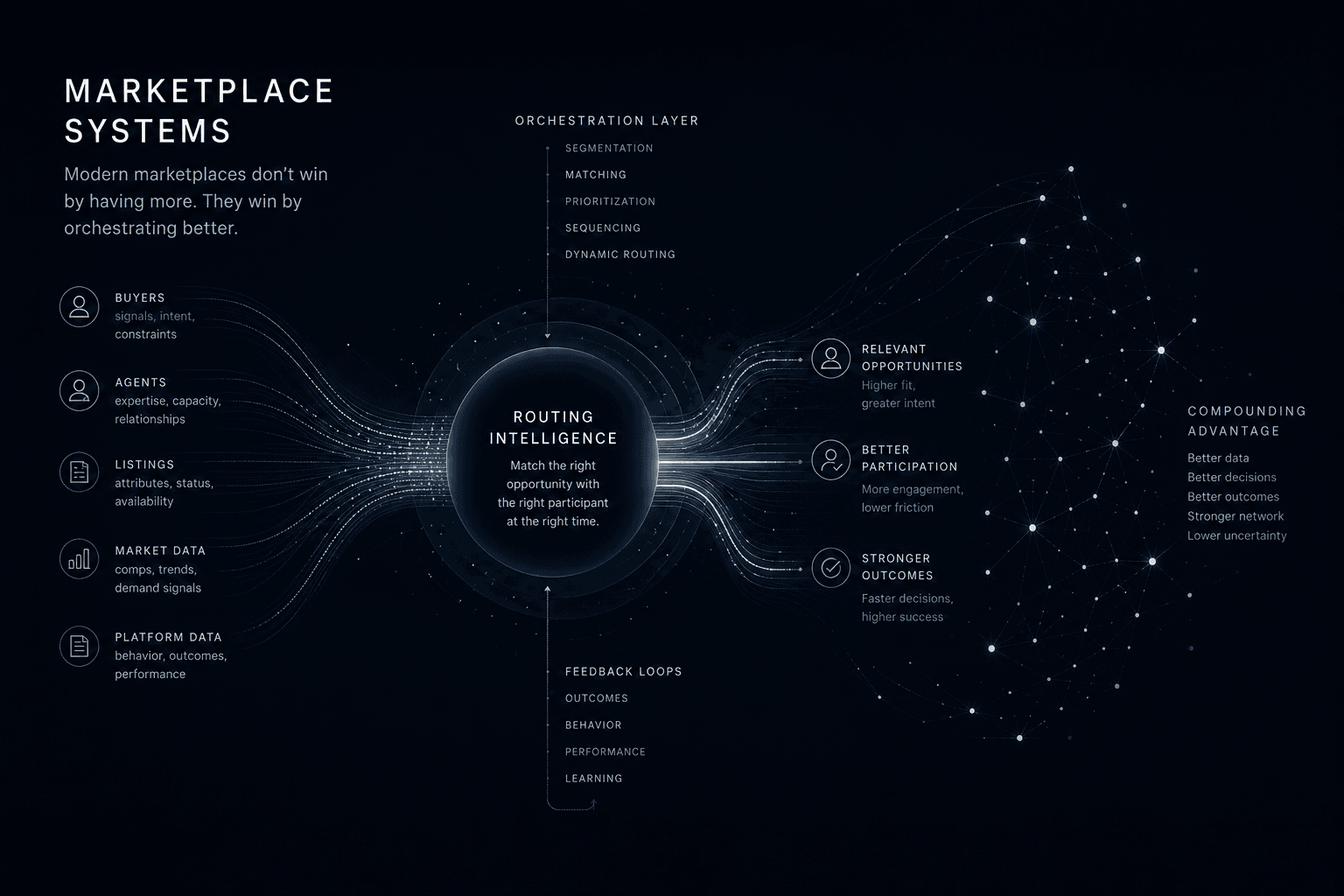
The shift
Most marketplaces optimize the wrong thing.
Most marketplace conversations focus on the same variables.
- More supply
- More demand
- More liquidity
- Faster matching
Those variables matter. But transaction marketplaces rarely fail because buyers and sellers cannot technically find each other.
They fail because uncertainty compounds faster than trust.
That distinction matters most in residential real estate, where users are not simply buying or selling. They are navigating timing risk, financial risk, emotional risk, financing constraints, and decision complexity at the same time.
The real product is not the transaction. It is the speed and quality of confidence formation.
The real challenge is not information. It is orchestration.
The mistake many real estate platforms make is assuming the problem is primarily informational:
- Show more inventory
- Generate more offers
- Connect more agents
- Capture more leads
But the real questions are different.
That is the actual system.
Liquidity is necessary but insufficient
A common assumption in marketplaces is simple.
More liquidity equals a better marketplace.
That is directionally true early on. Eventually it breaks.
Unmanaged liquidity creates noise faster than it creates value.
Too few offers reduces seller confidence. Too many offers can reduce participant quality. Weak routing creates investor fatigue. Inconsistent outcomes reduce trust.
At that point, the problem is no longer growth. It becomes control.
Early marketplace
- More buyers
- More offers
- More participation
- More reach
- More throughput
Mature marketplace
- Better routing
- Better relevance
- Better fit
- Better sequencing
- Better confidence formation
Early-stage marketplaces need access. Mature marketplaces need precision.
The future advantage is not, “we have the most buyers.” It is, “we know which buyers matter for this seller, under these conditions, at this moment.”
That is a fundamentally different capability.
Most transaction products ask for trust before they earn it.
This is the largest structural issue I see across transaction marketplaces.
The sequencing is backwards.
- A seller arrives with uncertainty
- The platform asks for personal information
- The seller gets routed into a human conversation
- Actual value appears later
The seller has already given attention, contact information, emotional energy, and sometimes financial information before receiving credible outcomes, meaningful comparisons, or actionable clarity.
The product creates interest.
The human closes the confidence gap.
That creates three structural problems. Scalability becomes constrained by people. Consistency deteriorates because outcomes vary by operator quality. The company loses the ability to systematically improve conversion because too much decision-making happens informally inside conversations.
This is one reason transaction marketplaces can struggle with low conversion despite high traffic and strong demand.
The issue is not awareness. The issue is confidence formation.
The value moment matters more than the lead
Most funnel optimization focuses on reducing friction, improving conversion rates, and increasing lead volume. Those matter.
But in high-friction transactions, the better question is: when does the seller first feel confident that this system can help them make a good decision?
That is the value moment.
In many systems, it arrives too late.
The decision is rarely just about price
They may be evaluating:
- Whether they can close on the next home
- Whether they can avoid carrying two mortgages
- Whether certainty is worth sacrificing upside
- Whether the process itself feels trustworthy
That is why tradeoff visibility is the product.

Perceived certainty often matters more than actual system capability.
A seller may not see meaningful offer quality for 24 to 48 hours. Tradeoffs between options remain unclear. Pricing rationale is poorly explained. Users do not understand what they are gaining or giving up.
So even when a platform technically delivers value, users do not fully perceive it. The marketplaces that win will move the value moment earlier.
The marketplace only works if trust compounds faster than uncertainty.
The goal is not perfect prediction.
The goal is faster confidence formation.
Through:
- Clearer scenario modeling
- Confidence ranges
- Better comparisons
- Transparent tradeoffs
- More structured decision support
Most transaction marketplaces are not constrained by demand.
They are constrained by how quickly they can manufacture confidence.
Scaling participation increases system entropy
One of the easiest mistakes in transaction marketplaces is assuming that expanding participation automatically strengthens the system.
It often does early. Later, it gets more complicated.
Every additional participant introduces:
- More variability
- More decision paths
- More communication overhead
- More expectation management
Bringing more agents, investors, or service providers into the system can expand reach. But it also increases system entropy unless decision quality is standardized, routing improves, marketplace relevance improves, and user confidence formation becomes more structured.
The opportunity is not replacing humans. It is reducing system entropy.
Humans become amplifiers of the platform.
Not substitutes for it.
Scaling participation before standardizing confidence formation is one of the easiest ways to destabilize a transaction marketplace. The result is usually lower trust, noisier liquidity, inconsistent user outcomes, weaker conversion efficiency, and increasing coordination cost.
The future advantage is not simply adding more participants. It is creating a system where additional participants improve marketplace quality instead of increasing marketplace noise.
The strongest marketplaces become control systems
This is the mental model shift that matters most.
Many marketplaces are still operating like directories:
- Aggregate participants
- Increase matching
- Maximize throughput
But aggregation breaks down as transaction complexity increases.
Directory model
- Aggregate participants
- Increase matching
- Maximize throughput
- Generate leads
Control system
- Shape incentives
- Engineer confidence
- Improve decision quality
- Orchestrate outcomes
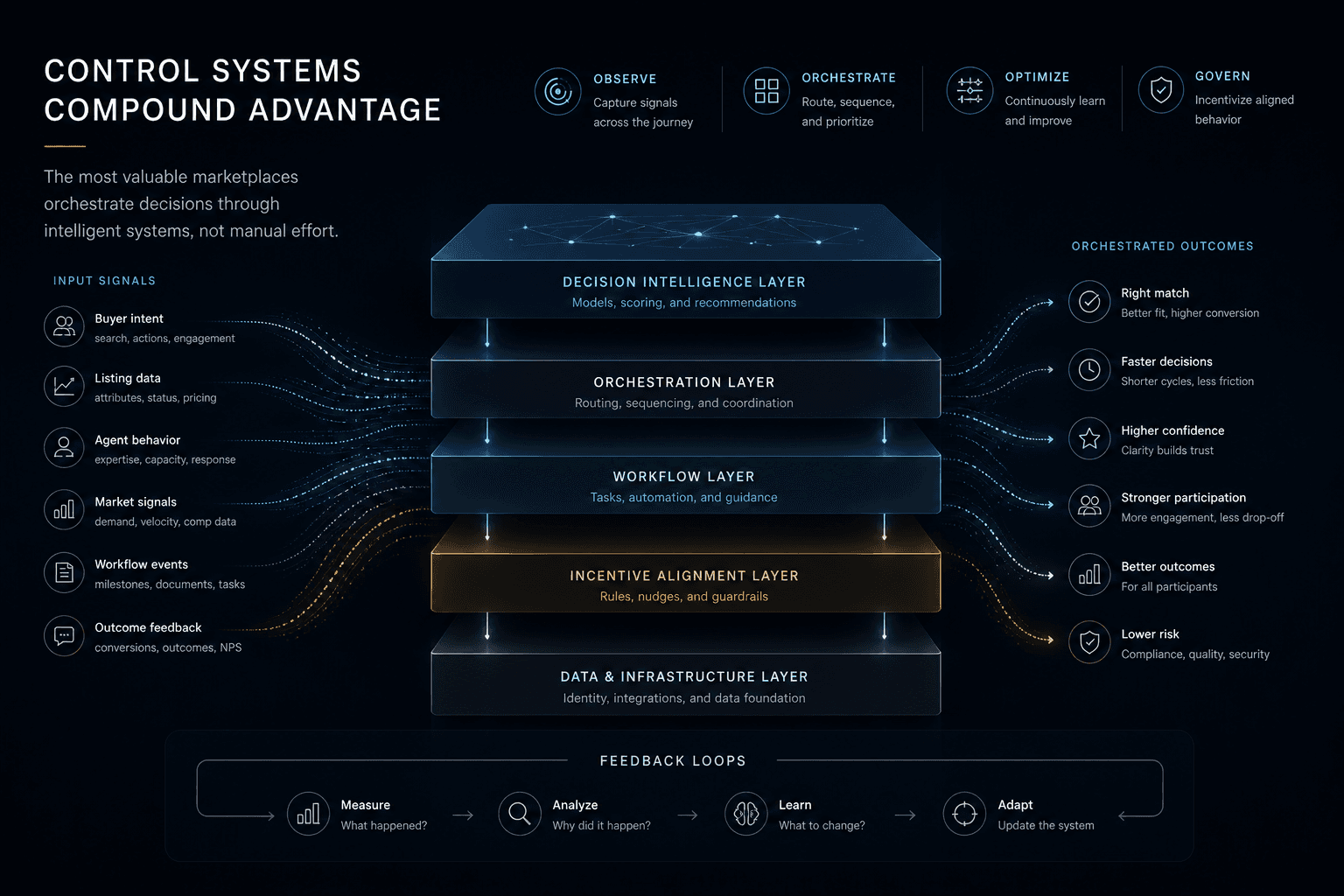
Decision infrastructure compounds. Simple access does not.
At that point, the company is no longer just facilitating transactions. It is orchestrating outcomes.
Workflow ownership compounds. Decision intelligence compounds. Behavioral data compounds. Operational playbooks compound.
Access can be replicated. Decision infrastructure is much harder to replicate.
What I would focus on first
If I were operating a transaction marketplace today, my priorities would be straightforward.
Framework moves
Move the value moment earlier.
Sellers should feel meaningful progress before human escalation becomes necessary.
Improve tradeoff visibility.
The problem is often not lack of offers. It is lack of confidence in what those offers mean.
Control liquidity quality.
A smaller number of highly relevant offers is often more valuable than a larger number of noisy ones.
Standardize trust formation.
The system should produce consistent outcomes independent of who answers the phone.
Instrument confidence formation.
Measure clarity, decision readiness, trust formation timing, and confidence, not just conversion.
Most transaction marketplaces do not have a demand problem. They have a confidence velocity problem.
What modern marketplace systems require
The next wedge is not more inventory, more agents, more buyers, or more traffic. Those are inputs. Not moats.
The company that controls how decisions get made eventually becomes more valuable than the company controlling listings.
Closing
This is not a traffic problem.
It is not a listings problem.
It is not even primarily a lead problem.
The next generation of transaction marketplaces will not win by controlling the most listings or traffic.
They will win because they reduce uncertainty faster than everyone else.
The winners will not look like listing portals.
They will look like transaction operating systems.
Confidence and decision infrastructure compound over time.
That is where the defensibility starts.
Liquidity matters.
But the real moat is becoming the system people trust to make the decision with.
If you are building marketplace systems
This is the underlying challenge modern transaction platforms are trying to solve.
Not more traffic. Not more listings. Better orchestration, better routing, and faster confidence formation.
Pass it to someone building in marketplaces.